A Smoke Detector
for the Heart.
Cardi/o® measures and displays heart rate and respiratory rate continuously, with no wearables needed, nothing to charge, and nothing for the patient or Care Team to do.
Prescription device. For use in healthcare facilities or home health care environments, by or under the supervision of healthcare professionals.

Gold, Emerging Technology 2026
Cardi/o® took Gold in the Emerging Technology category at the 16th annual McKnight's Excellence in Technology Awards, chosen by an independent national panel of 24 long-term care stakeholders.
NASA licensed radar technology
Technology exclusively licensed from NASA's Jet Propulsion Laboratory, reimagined for use in the AgeTech space.
The gap
What happened overnight?
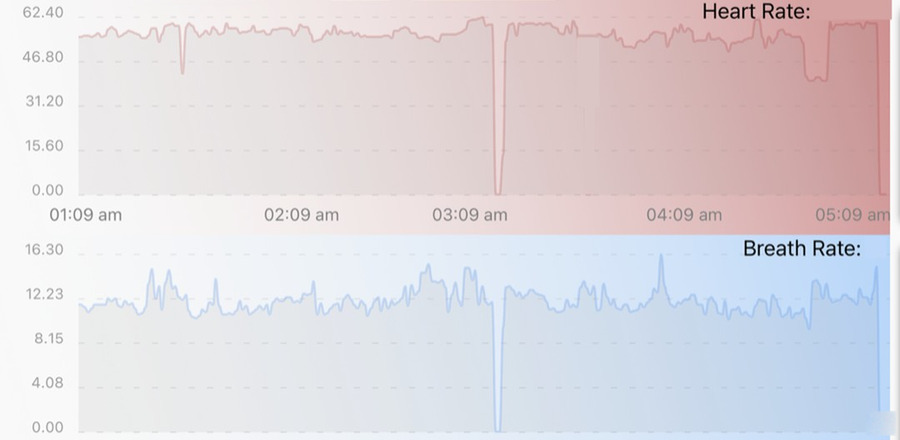
Staff often take heart rate and respiratory rate during their rounds. Spot checks tell a story at one moment in time. Cardi/o® measures heart rate and respiratory rate continuously, so Care Teams can see a more complete view over longer periods of time.
The longest stretch between Care Team rounds, and possible heart and respiratory spot checks, is overnight. At eight in the morning the Care Team needs to know who might need to see them first. Cardi/o® can help paint a clearer picture by offering a contactless radar solution with nothing to wear or charge.
Cardi/o® installs in the room, plugs into one socket in an outlet, and measures heart rate and respiratory rate through clothing and bedding whenever the patient is at rest within range.
A clinician's view
“As a cardiologist with 23 years experience I truly believe that constant heart rate measurement with touchless technology like this is the future.”
Jason Zagrodzky, M.D. Cardiology, Clinical Cardiac Electrophysiology. Texas Cardiac Arrhythmia Institute, St. David’s Medical Center, Austin.
What it measures
Two parameters, no wearables needed.
Heart rate
In beats per minute, measured and displayed live, and reported over time automatically with nothing for the Care Team to log individually.
Respiratory rate
In breaths per minute, measured and displayed live, and reported over time automatically with nothing for the Care Team to log individually.
Cardi/o® measures physiological oscillations. It reports heart rate and respiratory rate. Care Teams can view in real time as well as look back over periods of time and export data automatically. Open API connection.
How it works
Cardi/o® measures the micro vibrations on the surface of the body and extracts the oscillations of the heart and respiratory system. It reports heart rate and respiratory rate. Nothing is worn, and nothing touches the resident. Cardi/o® watches in the background while the individual is at rest and measures heart rate and respiratory rate overnight.
Mount, power, connect. The sensor is always on. No wiring, no drilling. The apps are available on both platforms, iPhone and Android, as well as a desktop portal for viewing readings on the floor.
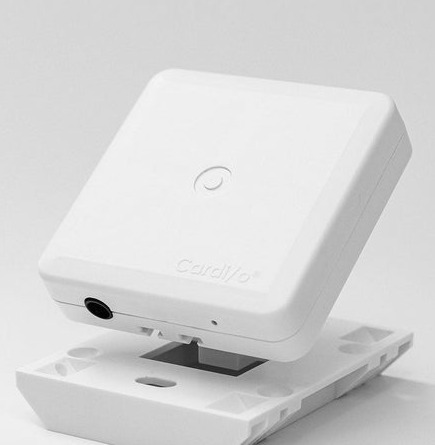
Three steps, and it is up and running.
-
Open the box
Sensor, bracket, adhesive strips, power supply and extension cord.
-
Mount it
Six feet above the floor.
-
Connect it
Wi-Fi and power are the only requirements.
Who we serve
Three ways Care Teams use Cardi/o®.
Designed for seamless deployment, Cardi/o® supports scalable patient management and potentially more proactive care, in healthcare facilities and home health care environments.
Remote Patient Monitoring (RPM) Partners and Platforms
Measured heart rate and respiratory rate, streamed to the partner platform over our API interface.
Home health
One sensor covers one individual at rest in either a bed or a chair within range of the radar, placed at admission and prescribed by the supervising clinician. Readings continue between visits.
Skilled nursing, nursing homes, and senior living
Continuous coverage overnight for each resident. Nothing to wear, charge or remember, and nothing for staff to collect between uses.
Sensors are recommended 8 feet apart for best results.
Coverage overnight, and nothing for the Care Team to log manually.
Privacy
No camera. No microphone. No wearable.
No image or audio is captured or stored. Cardi/o® uses privacy first ambient radar, exclusively licensed from NASA's Jet Propulsion Laboratory. It measures the micro vibrations on the surface of the body and extracts the oscillations of the heart and respiratory system.
About Advanced TeleSensors
Sensing life with no contact.
Born from a NASA pedigree and reimagined for the MedTech and AgeTech space.
We envision a world where Care Teams can access more robust information on those under their care without them being attached to a foreign object, poked, prodded, or tracked unnecessarily. We believe that continuous ambient heart rate and respiratory rate patterns presented in a seamless manner can save Care Teams valuable time and assist them in providing the most proactive care. Sensing life, with no contact, is the first advancement into this touchless world. We see Cardi/o® as one of the answers in not just meeting, but addressing, the Silver Tsunami.
Our values
We strive to uphold comfort, privacy, and individual empowerment supported by data for a better future.
About us
Who is behind Cardi/o®?
Leadership

Sajol Ghoshal
CEO and President
Serial executive with three exits totaling $3 billion. More than 30 years of leadership, strategy and engineering experience driving innovative sensing solutions, at Level One Communications, acquired by Intel for $2.2 billion, Agere, acquired by Lucent for $450 million, and TAOS, acquired by AMS for $350 million, as well as Akros Silicon and emerging sensor solutions at AMS-Taos. CEO of Advanced TeleSensors since July 2017.

Jason Zagrodzky, M.D.
Cardiology, Clinical Cardiac Electrophysiology
Training and expertise in cardiac electrophysiology, atrial fibrillation and ICD and pacemaker insertion. Principal Investigator on a 12 month FDA clinical trial sponsored by Abbott Medical Devices. Treated the first premature ventricular contraction case on a new cardiac mapping system at St. David’s Medical Center. Past president of the Alpha Omega Alpha National Honor Medical Society and recipient of the Mayes-Smith Award in Internal Medicine. Fellowship at UT Southwestern, and practices at Texas Cardiac Arrhythmia Institute, St. David’s Medical Center, Austin. Over 30 publications, including in The New England Journal of Medicine.

Tiffany Wey, MBA
Vice President of Sales & Marketing
Leading commercial strategy and global market expansion in senior living technology. Lifelong digital entrepreneur with a successful prior exit in the Big Data sector. Was promoted as a leader within Vayyar Imaging, joining through its acquisition of Dele Health Tech, where she led the transition of the Dele platform into the Vayyar brand and was promoted to drive market expansion across North America. MBA in Finance, Indiana State University.

Elisa Maldonado-Holmertz
FDA Regulatory and Quality Assurance
Leadership in the multinational biopharma and medical device industries across the USA, Belgium, Sweden and P.R. China. Roles at PPDI, Pfizer, Aerocrine and Emergo Group spanning pre-clinical, clinical, regulatory and quality functions. BA, University of Texas at Austin.
Board of Directors

Kirk Laney
Director
Semiconductor professional with 30 years building teams and companies for successful exits. Spun the Optoelectronic Products Group off from Texas Instruments in 1998 and built Texas Advanced Optoelectronic Solutions (TAOS) into a worldwide leader in opto-sensor solutions, acquired by ams AG (SIX: AMS) in 2011. Interim CEO of TAOS-ams AG until 2017, then Chief Strategy Officer on the ams Management Board.

Jacob Jacobsson
Director
CEO positions at Blaze DFM, Forte Design Systems and SCS Corporation, and executive positions at Xilinx, Cadence Design Systems and Daisy Systems. Served on the board of Actel Corp. (Nasdaq: ACTL) and currently serves on the boards of ams AG (SIX: AMS), RFMicron, Helic and Runtime. M.S. degrees in Computer Science and Electrical Engineering from KTH Stockholm.

Jack Syage, PhD
Director
CEO of ImmunogenX, with over 25 years creating and leading the development of innovative technologies in analytical instrumentation. Founded Syagen Technology, acquired in 2011 by Safran, and was appointed Chief Scientist for the subsidiary Morpho Detection. Over 130 published papers and more than 30 U.S. patents. PhD from Brown University, post doctoral work at Caltech under Nobel Laureate Ahmed Zewail.
Sajol Ghoshal and Jason Zagrodzky, M.D. also serve on the Board of Directors.
Advisory Board

Dr. Manu Sebastian
Professor, MD Anderson Cancer Center
PhD, DVM, DACVP, DABT, DECLAM. Faculty member at Dell Medical School. Two decades of scientific leadership across oncology, biopharma, medical devices and digital health.

John Beaman
President, Continuing Care, LLC
Founder and General Partner of The Bridges Assisted Living Homes in the Rio Grande Valley, 92 private rooms across two communities with staged levels of care including Alzheimer’s and memory care. 30 years in elder care assisted living. Formerly a New York commercial and investment banker specializing in lending to and raising capital for retirement and long term care homes.

John T. Armstrong
Chief Scientist, Radio Frequency
Over 40 years developing advanced technologies in spread spectrum communications, radar, pulse radar, sonar, surveillance, and real time tracking and location for medical devices. Named inventor on 22 U.S. patents. M.S. in electrical sciences from SUNY Stony Brook and a B.S. in physical chemistry from Caltech. Founded PROBE Science, Identifi, Senitron and MonsoonRF.

Eric Farrell, M.D.
Orthopedic Surgery
Clinical Professor at the UCLA Department of Orthopedic Surgery and a board certified orthopedic surgeon, fellowship trained in trauma. Assisted the US Navy aboard the USNS Comfort following the Haitian earthquake in 2010, and is an AAOS Registered Disaster Responder.
Important safety information
Who Cardi/o® is not for.
Cardi/o® is not intended for:
- Pediatric patients.
- Patients with a BMI greater than 30 kg/m2, or a heart rate outside 40 to 160 BPM.
- Monitoring in critical care settings.
- Use as a stand alone diagnostic or life support device.
The complete contraindications, warnings and precautions are in the Instructions for Use supplied with the device.
Cardi/o® is not intended for life critical or emergency monitoring. If you experience symptoms of a medical emergency, immediately contact your physician or emergency medical services (911).
Questions
Questions we are asked most.
Does Cardi/o® use a camera or a microphone?
No. No image or audio is captured or stored. Cardi/o® uses privacy first ambient radar, exclusively licensed from NASA’s Jet Propulsion Laboratory.
What does Cardi/o® report?
Heart rate in beats per minute and respiratory rate in breaths per minute, both measured and displayed live.
Does the resident have to wear or charge anything?
No. Nothing is worn and nothing touches the resident. There is nothing for residents to wear, charge or remember, and nothing for staff to collect between uses.
What does the sensor need to run?
Wi-Fi and power are the only requirements.
How many people does one sensor cover?
One sensor covers one individual at rest in either a bed or a chair within range of the radar.
Where does the sensor go?
On the wall, facing the bed, six feet above the floor. The Instructions for Use gives the clearances.
Is Cardi/o® an alarm or an emergency system?
No. Cardi/o® is not intended for life critical or emergency monitoring. If you experience symptoms of a medical emergency, immediately contact your physician or emergency medical services (911).
Who is Cardi/o® not for?
Cardi/o® is not intended for:
- Pediatric patients.
- Patients with a BMI greater than 30 kg/m2, or a heart rate outside 40 to 160 BPM.
- Monitoring in critical care settings.
- Use as a stand alone diagnostic or life support device.
The complete contraindications, warnings and precautions are in the Instructions for Use supplied with the device.
Where does Cardi/o® stand with FDA?
Advanced TeleSensors, Inc. registered Cardi/o® with the U.S. Food and Drug Administration in June 2026 as a Class II, 510(k) exempt device under 21 CFR 870.2675, product code DRZ, oscillometer. FDA registration does not denote approval or clearance of this device by FDA.
Can Cardi/o® feed the platform we already use?
Measured heart rate and respiratory rate are streamed to the partner platform over our API interface.
How do we get the Instructions for Use?
The Instructions for Use is supplied with every Cardi/o®. A revised version is in preparation and will be published on this site when it is released. For a copy now, email support@cardio.io or call (888) 292-2208, option 4, and give us the address we should send it to.
Instructions for Use
How to get a copy.
The Instructions for Use is supplied with every Cardi/o®. A revised version is in preparation and will be published here when it is released.
Need a copy now? We will send one. Email support@cardio.io or call (888) 292-2208, option 4. Please give us the address we should send it to.
Regulatory
Where we stand with FDA.
Advanced TeleSensors, Inc. registered Cardi/o® with the U.S. Food and Drug Administration in June 2026 as a Class II, 510(k) exempt device under 21 CFR 870.2675, product code DRZ, oscillometer.
FDA registration does not denote approval or clearance of this device by FDA.
Get started
Learn more about us
Tell us about the setting and we will arrange a demonstration.
Cardi/o® Support · support@cardio.io · (888) 292-2208, option 4